A unified framework for behavior-based identification and authentication of avatars and digital twins
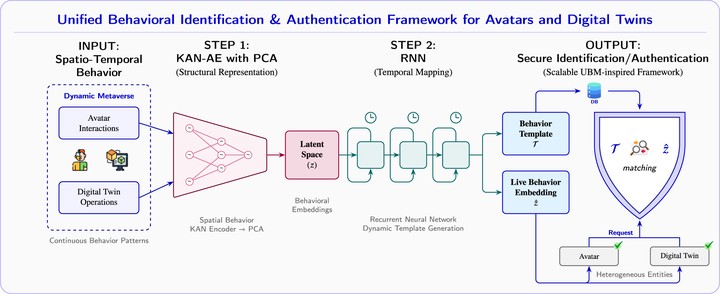 Graphical abstract of the proposed framework
Abstract
The socio-industrial metaverse is strengthening current cyber-physical systems where avatar (AV) and digital twin (DT) agents are used to represent users and physical entities across immersive, heterogeneous and dynamic platforms. It necessitates a robust authentication system for protecting the AV/DT from malicious attackers while maintaining secure access to all. Existing authentication approaches largely rely either on traditional credential-based mechanisms, which are inconvenient and vulnerable in immersive settings, or deep learning (DL)-based classifiers that lack scalability with population changes and often confuse identification with authentication. Moreover, prior behavior-based methods for AV remain task-specific, device-dependent, or limited to narrow interaction modalities, while DT identity security has remained limited to counterfeit detection. To address these limitations, this paper proposes a unified behavior-based identification and authentication framework while treating AVs and DTs collectively as behavior-generating agents. Firstly, we define agent behavior as a stochastic process characterized by deterministic and continuous state transformations over context-dependent interactions. Building on this formulation, we present a discriminative behavioral template generation method that combines spline-based spatial decomposition with temporal sequence modeling using a universal background model (UBM) inspired DL-based system for robust identity verification and management across heterogeneous behavior-generating agents. Experimental results demonstrate that the proposed approach achieves the best EER (7.94%) and AUC (0.9659) across five public and one in-house dataset - MetaPassAV. By unifying behavioral modeling for AVs and DTs, the proposed framework eliminates fragmented authentication mechanisms and enables scalable, consistent, and user-friendly identity verification across heterogeneous and dynamic metaverse environments.

Ravi Prakash Tripathi
Securing Metaverse Identities
A cybersecurity researcher specializing in the security of immersive technologies, with a focus on the socio‑industrial metaverse consisting avatars and digital twins.